





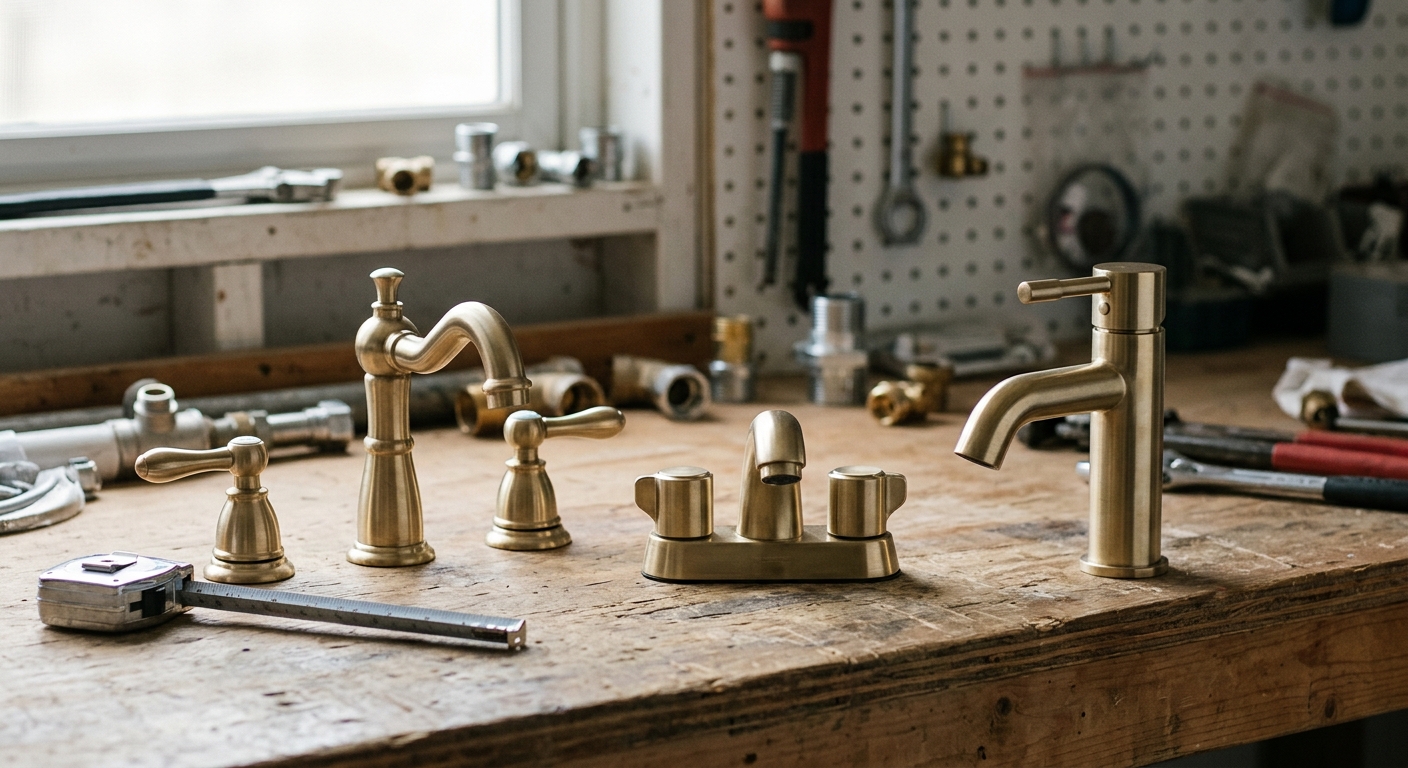
Faucet hole spacing is measured, not guessed, and it has to be confirmed before you order anything. The three common configurations, single-hole, centerset, and widespread, are not interchangeable, and a faucet bought on looks alone can leave you with a countertop that needs a new cutout or a deck plate you didn’t plan for. Measure your sink first, then shop.
Measuring Your Basin’s Hole Spacing First
Lay a tape measure across the existing holes in your sink or vanity top, center to center, not edge to edge. If you’re working from an old basin that’s already drilled, this number tells you exactly what faucet types will physically fit without modification. If you’re specifying a new countertop and sink before the faucet is chosen, the order reverses: you pick the faucet first, then hand that spacing to whoever is templating the counter.
Write the number down in inches, not “about four inches” or “standard.” Hole spacing on faucets is a fixed spec, not a style preference, and a quarter inch off is the difference between a faucet that drops in and one that doesn’t.
Widespread Faucets and the 8-Inch Spread Rule
Widespread faucets have three separate pieces, a spout and two handles, each with its own hole in the sink deck. The spread between the two outer handle holes runs from 8 inches up to 16 inches on-center, and the faucet you buy has to match (or have adjustable connectors that cover) your actual spread. Most widespread faucets on the market are built for the 8-inch spread, since that matches the majority of drilled vanity tops and basins, but wider options exist for custom stone counters or furniture-style vanities with wider decks.
If you’re sourcing three hole basin faucets for a widespread install, check the listed spread range before ordering, especially if your counter is already cut. Some widespread sets ship with flexible supply lines that tolerate a range of spacing, others are fixed, and the product page should state which.
Centerset Faucets at a Fixed 4-Inch Spread
Centerset faucets also use three holes, but the two handles and the spout are mounted on a single connected base, so the hole spacing is fixed at 4 inches center to center. There’s no adjustable range here the way there is with widespread. If your sink is drilled for a 4-inch spread, you need a centerset faucet, full stop, and a widespread unit will not sit flush even if the overall hole count matches.
This fixed spacing is actually an advantage when you’re replacing a faucet without replacing the sink: if the existing holes are 4 inches apart, you shop for “centerset” and you’re done, no spread range to double-check.
Single-Hole Faucets and Standard Cutouts
Single-hole faucets need exactly one hole, with the handle and spout combined into one fixture body. The cutout for these is typically 1-3/8 inch in diameter, which is a standard size across most sinks and countertops, so compatibility is rarely an issue once you know you’re working with a single-hole basin. Some single-hole faucets include an optional escutcheon plate for sinks with a slightly larger factory cutout, which covers the gap without needing to patch the counter.
Single-hole is the simplest configuration to plan around because there’s no spread measurement to get wrong, but confirm the cutout diameter on an older sink before ordering, since a handful of vintage basins use nonstandard hole sizes.
Deck Plates for Switching Faucet Types
A deck plate (also called an escutcheon or base plate) lets you install a single-hole faucet into a sink that’s drilled with three holes, typically a 4-inch centerset or 8-inch widespread pattern. The plate covers the extra holes while the single-hole faucet mounts through the center hole. This is the standard workaround when you want to upgrade to a single-hole faucet without replacing or re-drilling the countertop.
Deck plates solve a real problem, but they’re a compromise, not a style choice: they add a visible flat surface around the faucet base and limit you to single-hole faucets that specifically list deck-plate compatibility. A few things to check before relying on one:
- Confirm the plate’s finish matches or reasonably coordinates with the faucet, since mismatched metals are hard to unsee once installed.
- Measure the plate’s footprint against your sink deck to be sure it fully covers the unused holes.
- Check that the faucet manufacturer sells or supports a deck plate for that specific model, rather than buying a generic plate and hoping it fits.
Locking In Choice Before Countertop Templating
If you’re ordering a new countertop, the fabricator needs the faucet’s exact hole configuration before they template, not after. Countertop templating happens early in most renovation timelines, often before cabinets and flooring are finished, and the holes get cut (or the sink gets pre-drilled) based on the faucet spec you hand over. Changing faucet type after that point usually means a new cutout, a patch, or a deck-plate workaround you didn’t want.
The sequencing that avoids trouble is simple: choose the faucet, confirm its hole spacing in writing (spec sheet or box label), then release that number to the countertop fabricator or sink supplier. Don’t let “I’ll figure out the faucet later” survive past the templating stage.
| Faucet Type | Holes Required | Spacing |
|---|---|---|
| Single-hole | 1 | Cutout typically 1-3/8 in. diameter |
| Centerset | 3 | Fixed 4 in. center-to-center |
| Widespread | 3 | 8 to 16 in. center-to-center (verify exact fit) |
Before you order a faucet or sign off on a countertop template, measure your existing sink’s hole spacing (or confirm the new sink’s drilled pattern) and match it against the table above. If the numbers don’t line up with what you want to buy, decide now whether you’re changing the faucet choice, the sink, or adding a deck plate, rather than discovering the mismatch after the counter is cut. For anything involving stone or solid-surface countertops, loop in your fabricator before finalizing the faucet, since re-templating after fabrication is a real cost and delay, not a quick fix.